 newbusinessinside
Contractors managing several projects need equipment that can move efficiently between locations and perform consistently across different work environments. An electric scissor lift can be useful for interior construction, fit-out, maintenance, and installation tasks where vertical access is required without the operating profile of larger boom equipment. Procurement teams should therefore evaluate portability, working height, capacity, charging, dimensions, and service requirements before standardizing a fleet.
Start With the Common Jobsite Requirements
The first step is to identify tasks shared by multiple projects. Ceiling installation, lighting work, mechanical services, electrical installation, finishing, and routine maintenance may require similar working heights but different site conditions. A fleet specification should cover the most frequent applications while leaving enough flexibility for variations between projects.
An electric powered scissor lift can be especially relevant where equipment operates in areas with limited ventilation or where low-emission operation is preferred. However, selection should still consider floor conditions, indoor or outdoor working-height limits, allowable slopes, platform capacity, and available access routes. HSE guidance recommends assessing the work and site before selecting and using a MEWP.
Compare Working Height With Actual Tasks
Maximum working height is one of the most visible specifications, but it should not be the only procurement criterion. Contractors should identify the actual platform height required at their most common work areas and compare that requirement with ceiling heights, structural obstructions, and the need for workers to move materials on the deck.
Platform capacity is equally important when crews carry tools, components, and installation materials. Buyers should check the rated platform capacity and any separate limit for deck extensions. OSHA guidance emphasizes operating equipment within its applicable load limits and following manufacturer requirements, so procurement teams should include these specifications in their equipment comparison process.
Evaluate Mobility Between Work Areas
Multi-site contractors may move machines frequently within a project as well as between projects. Overall length, width, height, wheelbase, turning radius, and ground clearance therefore affect practical mobility. Compact dimensions can make it easier to negotiate entrances, corridors, loading areas, and other restricted routes.
Drive speed also influences how quickly operators can reposition equipment. A machine with a higher stowed travel speed can reduce unnecessary movement time, while controlled raised-speed operation can support positioning near work areas. Procurement teams should review these figures alongside site restrictions rather than judging maneuverability from machine size alone.
Consider Power and Charging Needs
Battery type and charging requirements become more important when the same equipment must support multiple projects. Contractors should establish where machines can be charged, how charging time fits into shift schedules, and whether their transport or storage procedures protect battery performance.
Modern electric machines may also use AC drive systems and lithium-ion batteries to reduce certain maintenance requirements. The exact system still varies by model, so buyers should compare battery capacity, charger rating, drive motors, charging arrangements, and manufacturer maintenance recommendations instead of assuming every electric machine has equivalent operating characteristics.
Standardize Where It Makes Sense
A multi-site fleet can become difficult to manage when too many machines use different controls, dimensions, and maintenance procedures. Standardizing selected models can simplify operator familiarization, spare-parts planning, inspections, and internal fleet management. A common specification can also make project scheduling easier because site teams know what capabilities to expect.
At the same time, standardization should not eliminate application-based selection. A contractor working mainly on interior fit-out may need compact machines, while another project may demand greater outdoor working height or higher platform capacity. A balanced fleet can combine standardized core equipment with specialized models where project requirements justify them.
The ZS0607AC-Li for Recurring Site Work
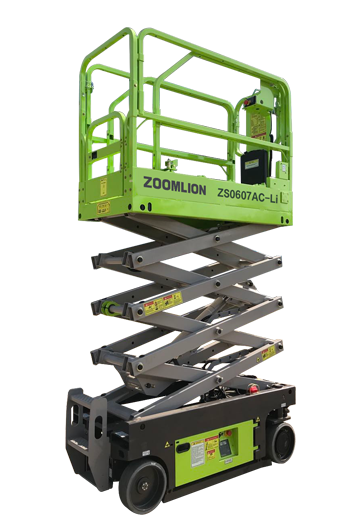
The ZS0607AC-Li from Zoomlion Access is an electric powered scissor lift with a maximum working height of 7.8 m indoors and 6.4 m outdoors. Its elevated platform height is 5.8 m indoors and 4.4 m outdoors. The rated platform capacity is 230 kg, while the deck extension has a separate capacity of 113 kg.
The machine has a 1.85 m overall length, 0.76 m overall width, and 2.20 m overall height with rails raised. With the rails lowered, overall height is 1.79 m. Its outside turning radius is 1.6 m, gross weight is 1,455 kg, and stowed drive speed is 4 km/h. These dimensions are useful when contractors assess transport and movement across multiple sites.
Power and Maintenance Details
The ZS0607AC-Li uses a 135Ah lithium-ion battery with a 24V/30A charger. Its lifting motor is rated at 24V/3.3 kW, while the drive motor is listed as 24V/0.65 kW. The model uses proportional control, front-wheel drive and braking, and an AC system. Zoomlion Access also lists IP67-rated waterproof protection for its AC wheel motors and lubrication-free, maintenance-free knuckles.
Why Zoomlion Access Fits a Multi-Site Fleet
Zoomlion Access currently offers more than 100 MEWPs across five categories, including scissor lifts, telescopic boom lifts, articulating boom lifts, spider lifts, and telehandlers. Its scissor-lift portfolio includes AC, lithium-ion, DC, HD, crawler, and rough-terrain configurations, covering different working-height and site requirements.
For contractors, this broader range can support a fleet strategy built around application requirements rather than a single machine format. The ZS0607AC-Li provides a 7.8 m indoor working height, 230 kg platform capacity, compact dimensions, and lithium-ion power. For an electric powered scissor lift, these specifications provide practical comparison points when planning recurring work across multiple job sites.
Build Procurement Around Fleet Reality
Multi-site procurement should consider what happens before, during, and after each job: transportation, site access, charging, operating height, platform loading, inspections, maintenance, and redeployment. An electric scissor lift should be selected according to these recurring requirements instead of maximum specifications alone.
The ZS0607AC-Li provides a compact example with defined dimensions, capacity, battery configuration, and working-height ratings. Contractors evaluating Zoomlion Access equipment can compare these specifications with their project portfolio and determine whether the model fits their common applications.