 newbusinessinside
An ARM single board computer can reduce power and simplify a compact edge device, while x86 preserves compatibility with established software. Vantron’s embedded board category includes both approaches, so the choice should follow the AI workload, operating system, interfaces, and thermal design.
For an AGV, inspection station, or energy gateway, edge AI means processing data near the machine instead of sending every camera frame or sensor record to the cloud. That reduces network dependence, but it places sustained compute, memory, storage, and software demands on the local board.
Define the Edge AI SBC workload
A single-board computer combines the processor, memory interfaces, I/O, expansion connections, and power circuitry on one circuit board. In an industrial deployment, the embedded board fits inside a larger enclosure, gateway, machine, or robot. It can connect directly to sensors, cameras, displays, storage, and network equipment.
Edge AI adds a complete processing pipeline. A warehouse vision station may capture images, preprocess them, run an inference model, trigger a PLC output, and record selected results. The CPU is only one part of that chain. Evaluate neural-processing support, camera interfaces, memory bandwidth, software frameworks, storage performance, and the required response time.
A short demonstration can hide sustained-load problems. Benchmark the board with the actual camera stream, model, storage activity, network traffic, and enclosure conditions. Each stage competes for memory bandwidth, power, and thermal capacity.
ARM reduces power and integration pressure
ARM architectures suit compact, power-sensitive devices. An ARM board can fit an autonomous mobile robot, solar controller, fleet gateway, or smart camera where enclosure space and energy use are limited. Lower system heat can simplify passive cooling inside a sealed box or near vibration-sensitive equipment.
The software stack shapes the benefit. ARM platforms often use Linux or Android with a board support package tailored to the processor family. NXP i.MX8 / i.MX9, Qualcomm, MediaTek Genio, and Rockchip platforms can differ in camera support, graphics acceleration, AI libraries, boot tools, and peripheral drivers. Confirm that the inference runtime supports your model format and update process.
Binary compatibility remains a practical limitation. An ARM board will not run legacy x86 applications without a porting or compatibility cycle. That affects proprietary machine-vision software, older database clients, industrial middleware, and development tools. Include migration work in the schedule instead of treating a compact board as a drop-in replacement.
ARM also leaves system validation in your hands. Check power sequencing, storage endurance, watchdog behavior, enclosure heat transfer, and recovery after power loss. A smaller board can shorten the hardware path, but it does not replace testing with the complete machine.
x86 preserves familiar software and peripherals
An x86 SBC can simplify a project built around desktop-class Linux or Windows applications, established industrial software, or existing development tools. A factory inspection station may already use x86-compatible vision libraries, database components, and operator software. Keeping that architecture can reduce porting effort and preserve tested application code.
The tradeoff often appears in power and heat. Higher sustained compute demand can require more careful airflow, heat spreading, or enclosure design. In a fanless control cabinet, the thermal path may limit usable performance more than a processor specification suggests. Active cooling can be acceptable in a ventilated cabinet when filters and maintenance fit the site.
The peripheral ecosystem may also favor x86. Industrial cameras, capture cards, storage devices, and specialized USB or PCIe equipment may have mature x86 drivers. Compatibility still depends on the exact operating system, driver version, connector arrangement, and maintenance plan. Check each device in the final configuration.
Which platform fits the complete AI pipeline?
Local inference can identify a defective part beside a conveyor and send only selected results upstream. That reduces uplink traffic and can keep basic operation available during a network interruption. It does not remove the need for remote updates, logs, security controls, and a recovery image.
Benchmark more than model execution. Measure image capture, decoding, resizing, color conversion, tensor movement, inference, post-processing, and machine response. A logistics robot may run vision alongside navigation, sensor fusion, and wireless communication. A neural accelerator can help only when the runtime accesses it and the model uses supported operators.
Keep the application boundary clear. An SBC running inference should not automatically be treated as a safety controller. Emergency stops, deterministic motion, and other protective functions belong on appropriately designed control hardware unless the complete architecture has been assessed for that role.
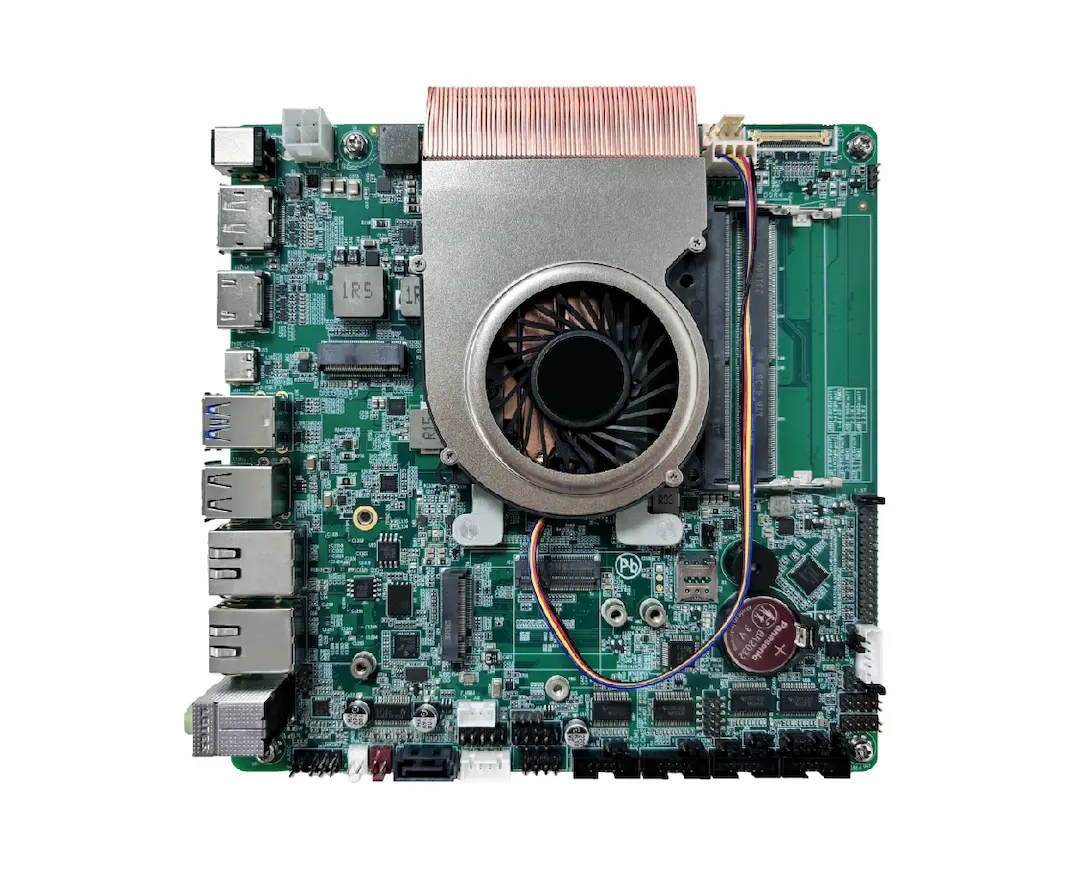
For mechanical planning, Vantron’s board category lists Intel platforms alongside ARM-based boards and includes standard 3.5-inch, Mini-ITX, and Pico-ITX form factors. These options affect enclosure reuse, expansion space, mounting, and cable routing. Board format is a mechanical decision as much as a processor decision.
Choose the SBC from deployment evidence
Choose ARM when low power, compact integration, passive cooling, or an ARM-native software stack carries the most weight. This fits an AGV perception unit, solar gateway, fleet telematics device, or distributed camera node where local inference is focused and the application can follow the selected board support package.
Choose x86 when existing software, Windows compatibility, specialized peripherals, or established development tools reduce more risk than lower power consumption. This fits a factory inspection workstation, industrial vision console, or control cabinet with enough thermal capacity and enclosure space.
For a long-running Edge AI program, review lifecycle planning, operating-system maintenance, driver ownership, replacement procedures, and technical support. More than 20 years of embedded experience and over 200 research personnel from a variety of fields give a supplier profile concrete evaluation points, but they do not prove that one board fits your design.
Before approval, test startup recovery, inference latency, network reconnection, storage behavior, display operation, and remote updates inside the final enclosure. Select an industrial single board computer from measured workload, not architecture labels alone. Vantron is one supplier example to include in that technical comparison.